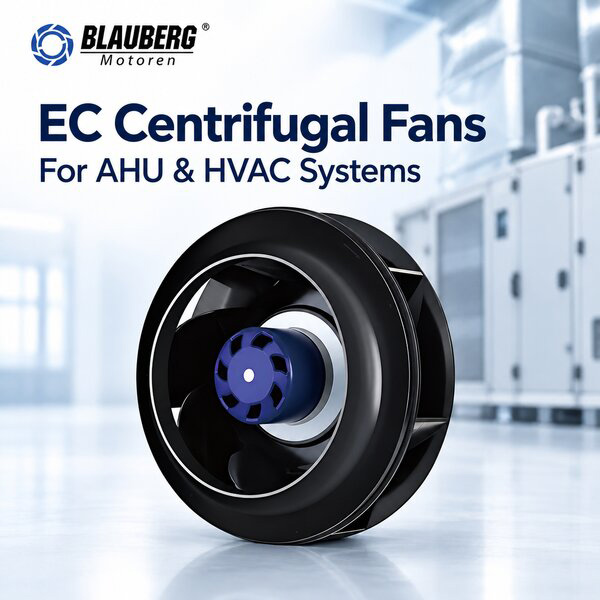
Selecting an EC centrifugal fan for an air handling unit involves more than matching an impeller diameter or choosing the highest airflow rating. The fan needs to deliver the required air volume against the resistance of the complete system, while meeting electrical, acoustic and installation requirements.
For equipment manufacturers and HVAC project teams, a practical selection process starts with the operating point. Airflow, static pressure and control compatibility should be considered together before a specific fan model is approved.
Why Consider an EC Centrifugal Fan?
An electronically commutated, or EC, fan combines a brushless motor with electronic commutation. Depending on the model, its control interface allows fan speed to be adjusted to suit changing ventilation requirements.
This makes EC technology relevant to HVAC equipment that needs to operate at different loads. However, actual energy consumption depends on the selected fan, its operating point and the control strategy. An EC motor alone does not establish how much energy a complete ventilation system will save.
Backward curved centrifugal fans are one option for air handling applications. Manufacturers offer different impeller designs and installation arrangements, so buyers should compare complete fan performance rather than relying on motor technology or blade shape alone.
Start with Airflow and Static Pressure
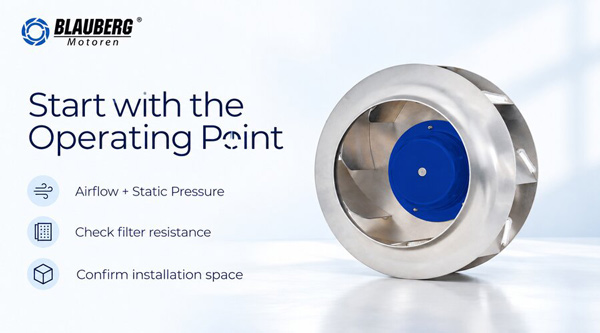
An air handling unit fan must move air through components such as filters, heat exchangers and ductwork. Each component contributes resistance that the fan must overcome.
A maximum airflow figure does not show how much air the fan will deliver once installed. The required airflow and pressure must be evaluated together on the fan performance curve.
Before requesting a selection, prepare:
· Required airflow, with clearly stated units.
· Required external static pressure and the losses included in it.
· Supply voltage and frequency.
· Available installation dimensions.
· Expected operating temperature and air conditions.
· Noise requirements and typical operating hours.
Filter condition also matters. A selection based only on clean-filter resistance may not represent the conditions experienced later in operation. Where airflow must be maintained as resistance changes, the system needs suitable sensing and control, together with adequate fan capacity.
Check EC Fan Speed Control Compatibility
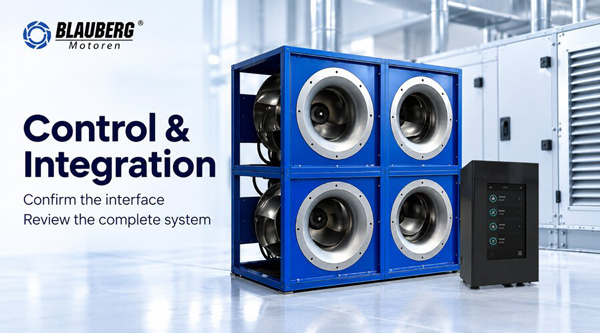
Speed control can help match ventilation output to demand, but the control interface must be confirmed for the exact model.
For example, Blauberg Motoren’s published information for the BL-B450D-EC-F05 lists 0–10 VDC and PWM speed control, together with an FG signal output. These are model-specific details and should be checked against the current wiring diagram before integration. See the Blauberg EC backward curved centrifugal fan product page.
A speed command should not be confused with automatic constant-airflow control. Maintaining a defined airflow requires an appropriate control arrangement. Similarly, a speed feedback signal does not directly measure the air volume passing through the equipment.
For an OEM project, confirming signal requirements early can prevent changes to the controller or wiring during assembly.
Evaluate Noise and Installation Together
A low-noise HVAC fan should be assessed under conditions that reflect the intended installation.
Restricted air inlets, nearby obstructions and unsuitable mounting arrangements can affect the airflow entering the impeller. The resulting installation may perform differently from the configuration used for published measurements.
When comparing centrifugal blower options, check whether acoustic figures refer to sound power or sound pressure, and whether the operating points and test conditions are comparable. A single decibel value is not enough to establish which fan will be quieter inside the finished unit.
Allowing suitable inlet clearance and reviewing the surrounding airflow path should therefore be part of the equipment design process.
Match the Fan to the Application
Different applications call for different selection priorities. An air handling unit may place particular emphasis on filter and heat-exchanger resistance. An air-cleaning device may require attention to compact installation and acoustic performance. Equipment cooling may involve a different operating schedule and control strategy.
Blauberg Motoren’s backward centrifugal fan range provides a starting point for reviewing available configurations. Final selection should be based on the relevant performance curve, dimensions, electrical information and environmental limits.
When replacing an existing fan, matching diameter alone is insufficient. The replacement also needs to meet the required duty point and fit the available mounting, electrical and control arrangements.
Prepare a Clear Fan Selection Request
A useful enquiry gives the supplier enough information to evaluate the application rather than simply quote a nominal fan size.
Include the required airflow and pressure, supply details, installation drawing, preferred control signal and noise target. For replacement projects, add the existing fan model and the operating conditions that need to be maintained.
To discuss an EC centrifugal fan for an AHU, HVAC unit or equipment-cooling project, contact Blauberg Motoren with these requirements. This provides a clearer basis for model comparison and technical review.